
Published October 22, 2026 · Category: Insights
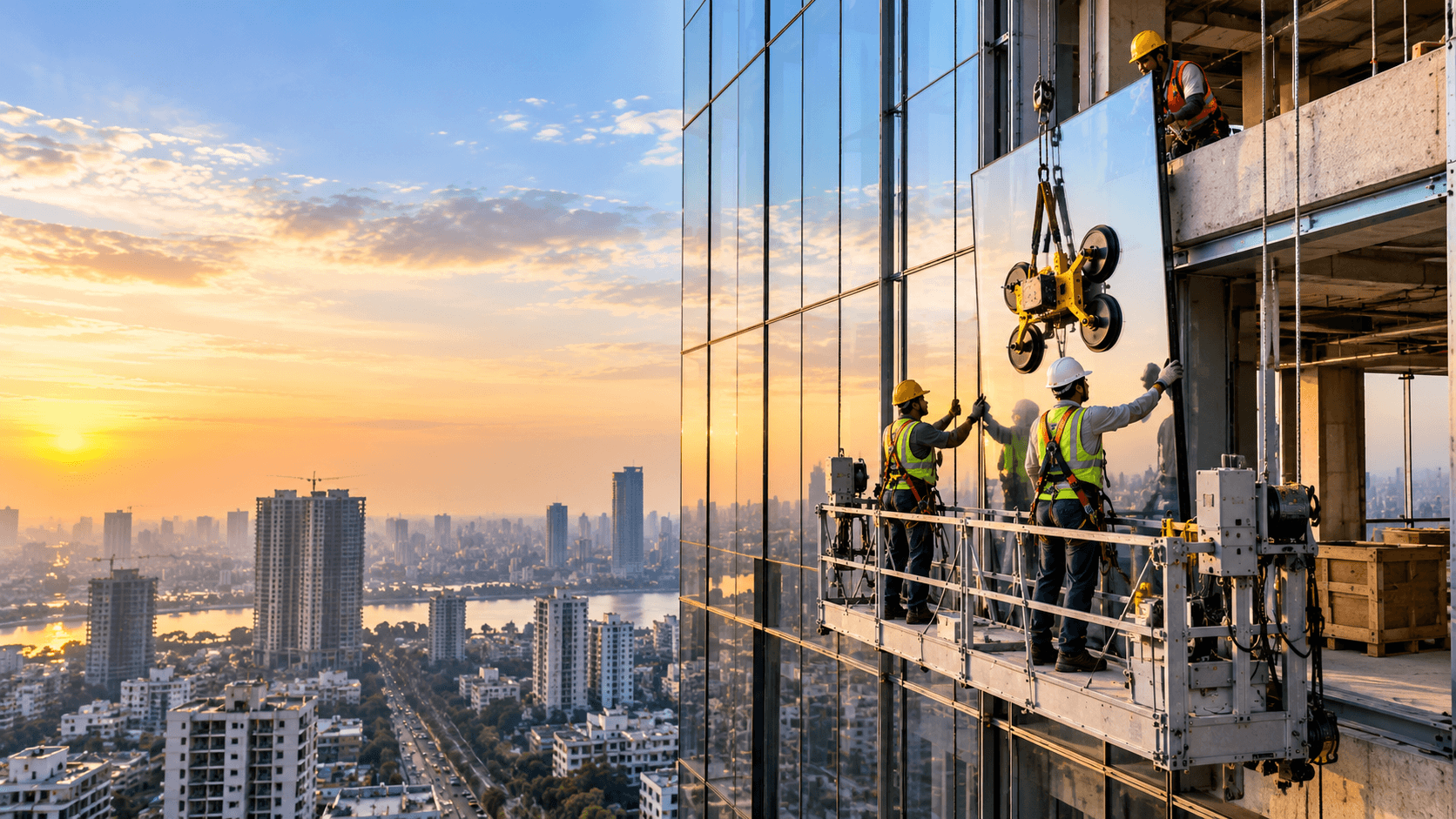
Every glass façade on an Indian tower comes down to one awkward problem: you have a 150–400 kg panel of glass at ground level, and it has to end up perfectly placed in a frame on the 25th floor, without a chip or a crack. Get the lifting method wrong and you pay for it in broken glass, crane hire hours and a programme that slips week after week. This guide walks through the equipment and methods contractors actually use for high-rise glass installation in India, how to size the lift for your panels, and what each option realistically costs in 2026.
Key Takeaways
• There are four practical ways to get glass up a tower: tower crane, mobile crane, terrace-mounted glass hoist and manual/in-floor lifting. Each suits a different building and budget.
• Glass weighs about 2.5 kg per m² for every millimetre of thickness — a 1.5 m × 3 m double-glazed unit is roughly 135 kg before the vacuum lifter is added.
• A terrace-mounted hoist like the Boltrack BE500 (500 kg, up to 100 m lift) frees the project from crane availability and lets glazing run floor by floor on your own schedule.
• The fastest façade crews pair a glass hoist with a suspended platform: the hoist places the panel, the crew on the platform fixes and seals it.
Contents: The four installation methods · How a glass hoist works · Sizing the lift for your panels · Boltrack BE500 specifications · Hoist + suspended platform · Safety at height · Cost in India (2026) · FAQ
🏢 The Four Ways to Install Glass on a High-Rise
Whether the job is a unitised curtain wall on a commercial tower, structural glazing on a hospital or large windows on a residential block, the glass has to be lifted to floor level and then positioned into the frame. In India that is done in one of four ways.
| Method | Best for | Main drawback |
|---|---|---|
| Tower crane | Glazing that starts while the structure is still going up and the crane is already on site. | Glass competes with every other trade for crane time — and the crane often leaves before glazing ends. |
| Mobile crane | Low and mid-rise buildings with open ground access along the façade. | Height-limited, needs road or ground space, and is expensive by the hour or shift. |
| Terrace-mounted glass hoist | Towers after the crane is gone, retrofits, replacements and tight city plots. | Needs a terrace or roof slab that can take the counterweight, and a trained operator. |
| Manual / in-floor lifting | Small panels carried up by lift or stairs and fitted from inside. | Slow, labour-heavy, and simply impossible for large or heavy units. |
On most Indian tower projects the real choice is between the tower crane and a dedicated glass hoist. The crane looks free because it is already on site — but once you count the hours glazing spends waiting for it, and the fact that it is usually demobilised before the façade is finished, a hoist that belongs to the glazing team alone tends to win on programme.
⚙️ How a Terrace-Mounted Glass Hoist Works
A glass handling hoist is a compact, wheeled lifting machine that sits on the roof or terrace, reaches out over the parapet with a boom, and lowers a wire rope down the face of the building. The glass is picked up at ground level with a vacuum lifter, raised to the target floor, and then eased into position while the installation crew guides it in.
The main parts are:
• Chassis and castors — a heavy-duty steel frame on locking swivel wheels, so the hoist can be rolled along the terrace from one bay to the next.
• Boom — an articulating and telescopic arm that sets how far out from the building edge the rope hangs. More outreach clears projecting slabs and fins, but reduces the safe load.
• Motor, gearbox and brake — an electric motor with a self-locking gearbox and brake, so the load holds still the moment you stop.
• Counterweight — modular steel weights at the back of the chassis that stop the machine tipping forward under load.
• Controls — a wireless remote so the operator can stand where they can see the glass, with a wired pendant as backup.
• Limit and emergency switches — cut the motion at the top of travel and stop everything instantly when needed.
Because it is a fixed piece of equipment that belongs to the glazing team, the hoist can work from first light to last, on the floors you choose, without waiting for a crane slot.
→ See the Boltrack Glass Handling Hoist with site photos
📏 Sizing the Lift: How Heavy Is Your Glass?
Before choosing any equipment, work out the heaviest single lift on the job. Glass has a density of about 2,500 kg/m³, which gives a very handy rule: every millimetre of thickness weighs about 2.5 kg per square metre.
| Glass type | Weight per m² | 1.5 m × 3 m panel (4.5 m²) |
|---|---|---|
| 6 mm toughened | 15 kg | ≈ 68 kg |
| 10 mm toughened | 25 kg | ≈ 113 kg |
| 12 mm toughened | 30 kg | ≈ 135 kg |
| DGU 6 + 12 air + 6 | 30 kg | ≈ 135 kg |
| Laminated DGU 6.38 + 12 + 8 | ≈ 36 kg | ≈ 162 kg |
| Unitised curtain wall panel (glass + aluminium frame) | Varies by system | Commonly 200–400 kg — check the façade drawings |
Weights are approximate glass-only figures. The air gap in a DGU adds almost nothing; spacers, sealant and frames add more.
Then add everything else that hangs on the rope: the vacuum lifter or suction frame, any spreader beam, slings and shackles. The total is your working load. Finally, check it against the hoist’s load chart at the boom outreach you will actually use — a hoist rated for 500 kg close in will safely carry less at full extension. A sensible rule is to keep your heaviest lift comfortably inside the chart, not right at its edge.
🧰 Boltrack BE500 Glass Handling Hoist — Specifications
The Boltrack BE500 is built in Ahmedabad specifically for high-rise glass placement on commercial and residential towers. Here are the key numbers.
| Specification | Boltrack BE500 |
|---|---|
| Rated lifting capacity | 500 kg (load-chart based for boom extension) |
| Maximum lifting height | 100 m |
| Lifting speed | 0 – 20 m/min, variable |
| Boom | Articulating and telescopic, max extension 2,200 mm |
| Motor and gearbox | 5.0 hp double-brake motor (IP55), helical auto-lock gearbox |
| Wire rope | 10 mm non-rotating galvanised (6×19 + IWRC), 100 m |
| Controls | Wireless joystick remote (200 m range) + wired pendant backup |
| Counterweight | Modular steel, 35 × 50 kg pieces |
| Mobility | 8″ polyurethane swivel castors with floor locks |
| Safety | Limit switch cut-off, emergency stop |
| Transport size | 1,600 × 1,400 × 1,800 mm |
Two details matter most on site. The variable speed lets the operator lift quickly through open air and then creep the last few centimetres into the frame — exactly where most glass gets damaged. And the 200 m wireless remote means the operator does not have to stand at the terrace edge guessing; they can watch the panel from the floor where it is being fixed.
Planning a glazing package?
Send us your panel sizes, glass make-up and building height. We will tell you whether the BE500 suits your heaviest lift and quote for purchase or rental — usually the same day.
Get a BE500 Quote → 💬 WhatsApp Your Drawings🔗 Glass Hoist + Suspended Platform: The Fastest Combination
A hoist gets the glass to the right floor. Somebody still has to stand outside the building to guide it into the frame, fix the brackets and run the sealant. For anything that cannot be done entirely from inside the slab, that means a suspended platform (gondola).
On a typical façade the sequence looks like this:
1. Pick up. The panel is attached to the vacuum lifter at ground level and checked for a full seal before it leaves the ground.
2. Lift. The hoist raises the panel up the drop at full speed, with a tag line controlled from below to stop it swinging.
3. Position. Near the target floor the operator slows to creep speed while the crew inside and on the platform take hold of it.
4. Fix. The panel is set into the frame; the platform crew fixes and seals from outside while the inside crew secures it from the slab.
5. Move on. The hoist rolls to the next bay and the platform moves to the next drop.
For glazing work we usually recommend the 1,000 kg ZLP1000, which has enough capacity for two or three workers plus tools, sealant and fixings; the 800 kg ZLP800 suits lighter window and sealant work. Where the façade turns a corner, an L-type platform keeps the crew working without re-rigging. Because Boltrack supplies both the hoist and the platform, the two can be planned together — the same terrace layout, counterweight plan and drop positions.
🛡️ Safety When Lifting Glass at Height
A large glass panel is heavy, fragile and — in wind — behaves like a sail. These are the points that keep the lift safe:
• Check the terrace first. Confirm the roof slab can take the hoist and its counterweight, and never rest the boom or chassis on a parapet that has not been checked.
• Stay inside the load chart. Use the total hung weight — glass plus lifter plus rigging — at the outreach you will actually use.
• Watch the wind. Set a wind limit for the job in your lifting plan and stop when gusts exceed it. A panel that swings into the building can break itself and injure the crew.
• Barricade the drop zone. Nobody stands or walks under a suspended load. Mark and guard the full area below the lift.
• Inspect the vacuum lifter every time. Clean pads, a full vacuum reading and a working loss-of-vacuum alarm before every lift.
• Use tag lines. Control the panel from below so it never spins or swings into the façade.
• Trained, certified operators. Under the Building and Other Construction Workers (BOCW) rules, lifting appliances must be examined by a competent person and operated by trained workers. Keep the inspection records on site.
• Harness and lifeline. Workers at open slab edges and on suspended platforms stay clipped to an independent lifeline at all times.
For a full rundown of platform-side safety, see the safety section of our suspended cradle lift guide.
💰 High-Rise Glass Installation Cost in India (2026)
The equipment bill for a glazing package depends on height, the number of panels, how long the façade programme runs and whether you buy or rent. The table below gives the shape of the costs for each method.
| Equipment | How it is charged | What drives the cost |
|---|---|---|
| Tower crane (already on site) | Shared site cost | Waiting time for crane slots; extending crane hire just for glazing is very expensive. |
| Mobile crane | Per hour or per shift | Tonnage and boom length needed for the height; minimum shift charges; road permissions. |
| Boltrack BE500 glass hoist | Buy outright, or monthly rental | Lifting height, rental duration, delivery distance. Price on request — quoted per project. |
| ZLP800 suspended platform | From ₹35,000/month rental, or from ₹2.65 lakh to buy | Plus transport and installation per deployment. |
| ZLP1000 suspended platform | From ₹3.9 lakh to buy; rental on request | Best suited to heavy glazing and cladding crews. |
Boltrack prices exclude 18% GST. Crane costs vary widely by city and operator — get local quotes to compare.
The number that matters is not the monthly rent, it is the cost per panel installed. A crane that costs less per day but only gives glazing a few hours of hook time can end up far more expensive per panel than a hoist that works the full shift. When you compare options, divide the total equipment cost by the number of panels you expect to fix in that period.
On rent versus buy, the logic is the same as for suspended platforms: rent for a single project, buy once the machine will move from tower to tower. Our buy vs rent cost breakdown shows how to work out the break-even point, and the city-wise rental price guide covers platform rates around India.
Get a Free Quote → See Our Projects
❓ Frequently Asked Questions
How is glass installed on high-rise buildings?
Glass is lifted from ground level to the target floor using a tower crane, mobile crane or a terrace-mounted glass hoist, picked up with a vacuum lifter. Near the floor it is slowed down and guided into the frame by a crew working from inside the slab and, for external fixing and sealing, from a suspended platform. Small panels can be carried up internally and fitted from inside.
What equipment is used to lift glass to upper floors?
The main tools are a lifting machine — crane or glass handling hoist — and a vacuum lifter or suction frame that grips the glass. A suspended platform gives the crew safe access to the outside of the building for fixing and sealing, and tag lines control swing during the lift.
How much does a glass panel weigh?
Glass weighs about 2.5 kg per square metre for every millimetre of thickness. A 12 mm toughened panel or a 6+12+6 double-glazed unit weighs about 30 kg/m², so a 1.5 m × 3 m panel is roughly 135 kg. Add the weight of the vacuum lifter and rigging to get the total load on the hoist.
Can a glass hoist replace a crane?
For most glazing work after the structure is complete, yes. A terrace-mounted hoist such as the Boltrack BE500 lifts up to 500 kg to 100 m, which covers the majority of glass panels and many unitised units on Indian towers. Very large or very heavy units, beyond the hoist’s load chart, may still need a crane.
How high can the Boltrack BE500 lift glass?
The BE500 has a maximum lifting height of 100 m with 100 m of 10 mm non-rotating wire rope — roughly a 30-storey building. Lifting speed is variable from 0 to 20 m per minute, so the operator can slow right down for final positioning.
Can the glass hoist be used together with a suspended platform?
Yes, and that is how the fastest façade crews work. The hoist places the panel and the crew on the suspended platform fixes and seals it from outside. Boltrack supplies both, so the terrace layout and drop positions can be planned together.
Is glass lifting equipment available on rent in India?
Yes. Boltrack Engineers offers the BE500 glass handling hoist and its suspended platforms on rental as well as for outright purchase, with delivery across India from Ahmedabad. Share your building height, panel sizes and project duration for a quote.
About Boltrack Engineers
Boltrack Engineers is a manufacturer, supplier and rental provider of suspended platforms, cradles, gondolas, glass handling hoists and construction equipment, based in Bakrol GIDC, Ahmedabad, Gujarat. We supply the BE500 glass handling hoist, the ZLP500, ZLP630, ZLP800 and ZLP1000 series, L-type platforms, cantilever crane loading platforms and full spare parts — for outright purchase or monthly rental anywhere in India. New to the equipment? Start with our guide to what a construction gondola is and how it works.
📞 Sales: +91 78744 95518 | 💬 WhatsApp us | ✉️ Request a quote
