
📅 Last updated: August 2026 ⏱ Reading time: ~9 minutes 📍 Region: India (Pan-India)
Key Takeaways
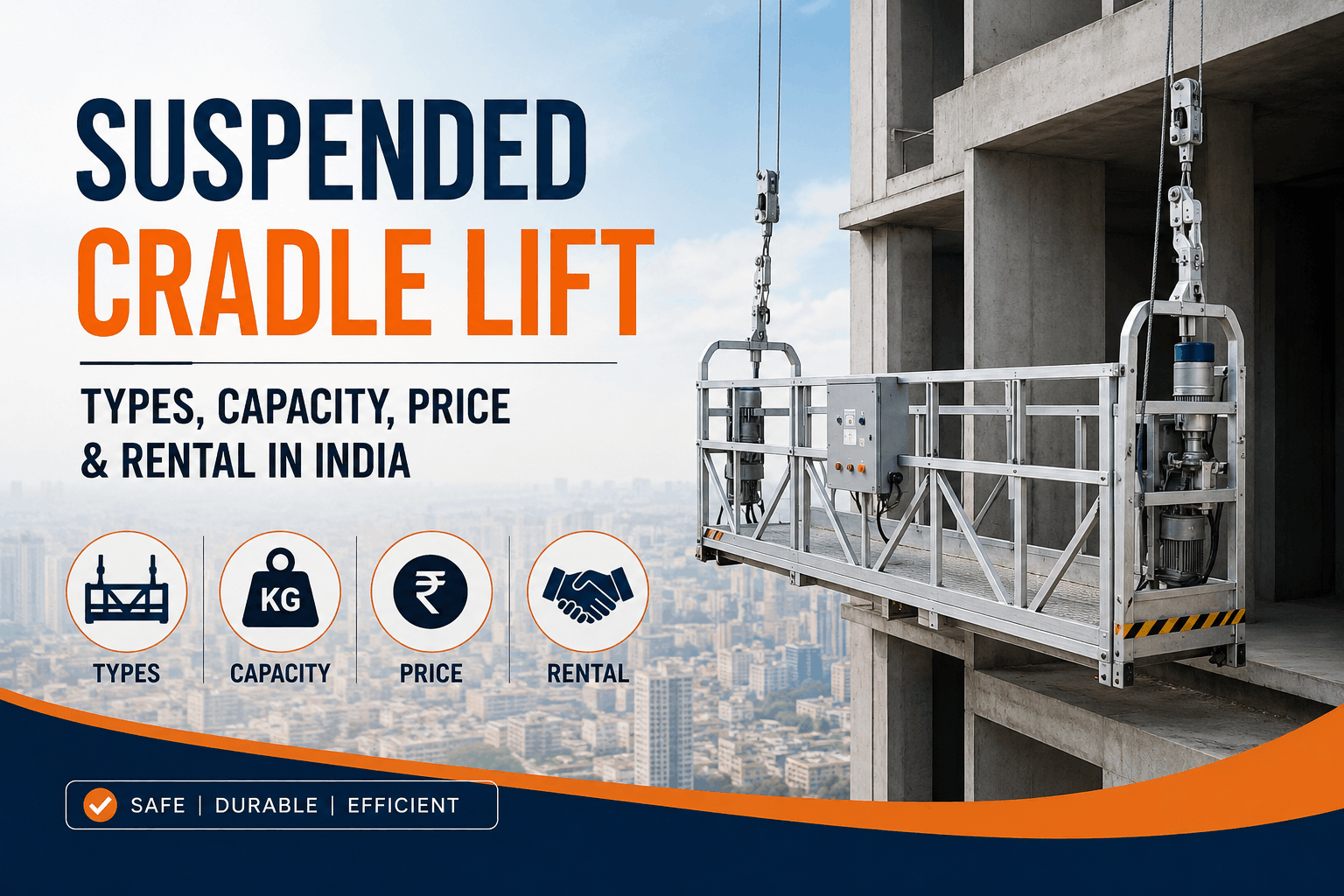
- A suspended cradle lift is a motorised work platform hung from a building roof on steel wire ropes, raised and lowered by electric hoists so workers can reach any point on a façade without ground scaffolding.
- “Cradle lift”, “suspended cradle”, “construction cradle”, “gondola” and “rope suspended platform” all describe the same category of equipment — the name changes by region and trade, not by machine.
- Standard capacities run from 500 kg to 1,000 kg, with the ZLP800 (800 kg) being the most widely used model on Indian sites.
- Cradle lengths typically range from 1 m to 7.5 m in modular sections, so the platform can be built to match the façade bay width.
- A new cradle costs roughly ₹2,55,000–₹2,68,000 for a ZLP800 and around ₹3,95,000 for a ZLP1000 (excluding 18% GST). Rental runs about ₹20,000–₹50,000 per month depending on city and model.
- Boltrack Engineers manufactures and rents the full suspended cradle lift range across India.
Contents
- What is a suspended cradle lift?
- How a suspended cradle lift works
- Types of suspended cradles
- Capacity, size and specifications
- Where construction cradles are used
- Cradle, gondola or suspended platform — what’s the difference?
- Suspended cradle lift price in India
- Renting vs buying a cradle lift
- Safety requirements and installation
- Frequently asked questions
🏗️ What Is a Suspended Cradle Lift?
A suspended cradle lift is a temporary, motorised work platform that hangs from the roof of a building on steel wire ropes and travels vertically along the façade using electric hoists. Workers stand inside the cradle — a galvanised steel basket with guardrails on all sides — and drive it up or down to whatever height the job requires.
The defining feature of a cradle lift is that it carries no load to the ground. Everything is supported from above, by outrigger beams with counterweights or by parapet clamps anchored on the roof slab. That is what separates it from scaffolding, mast climbers and boom lifts, all of which need a stable base at ground level.
Because the cradle hangs rather than stands, height stops being a cost variable. Reaching the 24th floor of a residential tower costs the same in equipment as reaching the 4th — you simply spool out more rope. On a full-height scaffold, the 24th floor costs six times what the 4th does. That single economic fact is why suspended cradles have become the default access method for high-rise façade work across Indian construction.
⚙️ How a Suspended Cradle Lift Works
A complete suspended cradle system is made of three groups of parts: what holds it up on the roof, what carries the load down the building, and the powered platform itself. Here is what each component does.
| Component | What it does |
|---|---|
| Suspension mechanism | Outrigger beams loaded with counterweights, or a parapet clamp gripping the roof parapet. This is the anchor for the entire system. |
| Working rope | The steel wire rope the hoist climbs, carrying the full working load. Standard supplied length is 50 m, extendable to building height. |
| Safety rope | A completely independent second rope carrying no load in normal use. It exists purely to catch the cradle if the working rope fails. |
| Electric hoists | Two LTD-series hoist motors, one at each end, that grip and climb the working rope to raise and lower the platform. |
| Steel cradle | The galvanised modular basket where workers, tools and material sit. Assembled in sections from 1 m to 7.5 m total length. |
| Centrifugal safety lock | Clamps onto the safety rope the instant the cradle over-speeds or tilts beyond a set angle. This is the single most important safety device on the machine. |
| Control panel | Operates both hoists together or independently, with an emergency stop and upper and lower limit switches. |
In use, the crew boards the cradle at ground or roof level and the trained operator drives the hoists from the control panel. Because both ends are driven together, the platform stays level as it travels. If one hoist runs faster than the other and the cradle tilts, the safety lock bites the second rope and stops the movement before the tilt becomes dangerous.
→ Explore the full Boltrack suspended platform range
🧰 Types of Suspended Cradles
Not every building is a flat rectangle, so construction cradles are built in several geometries and capacities. The right choice depends on three things: the shape of the façade, the total weight you need to carry, and how the roof allows the system to be anchored.
| Cradle type | Capacity | Best suited to |
|---|---|---|
| ZLP800 cradle | 800 kg | The all-round standard. Painting, plastering, cleaning and general façade work on straight elevations. |
| ZLP1000 cradle | 1,000 kg | Heavier façade work — larger crews, cladding panels, stone veneer, glazing units. |
| L-type cradle | 630–1,000 kg | Building corners, recessed balconies and stepped elevations a straight cradle cannot reach into. |
| Round / chimney cradle | 500–800 kg | Chimneys, silos, cooling towers and curved façades — the cradle is shaped to wrap the curve. |
| Gondola platform | 800 kg | Routine building maintenance and window cleaning on completed towers. |
| Special purpose cradle | Built to spec | Heritage structures, bridges, dams, ship hulls and any geometry a catalogue model cannot serve. |
📏 Capacity, Size and Specifications
The number in a model name is the rated load in kilograms — a ZLP800 is rated for 800 kg, a ZLP1000 for 1,000 kg. That figure is the total of everything the cradle carries: workers, tools, paint, mortar, panels and the weight of any accessories added to the platform.
A practical way to size it: allow 80 kg per worker, then add your material and tool weight, then add a comfortable margin. Three workers with tools and a day’s paint will sit well inside a ZLP800. Four workers handling glazing units or stone will not — that is a ZLP1000 job.
| Specification | Typical range |
|---|---|
| Rated load capacity | 500 kg / 630 kg / 800 kg / 1,000 kg |
| Cradle length (modular) | 1 m to 7.5 m, assembled from standard sections |
| Lifting speed | Approximately 8–10 m per minute |
| Wire rope diameter | 8.3 mm or 8.6 mm galvanised steel, working and safety rope |
| Standard rope length supplied | 50 m, extendable to suit building height |
| Power supply | Three-phase 415 V, 50 Hz |
| Counterweight per outrigger | Calculated per installation — never assume a standard figure |
🎯 Where Construction Cradles Are Used
A cradle lift earns its place anywhere a crew needs repeated, controlled access to a vertical surface that is too tall for a ladder and too slow for full-height scaffolding. The most common applications on Indian sites are:
- Exterior painting and plastering — by a wide margin the most common use. One crew works an entire elevation floor by floor from the roof down.
- Glass façade and curtain wall installation — positioning, sealing and finishing glazing panels on commercial towers.
- Building maintenance and window cleaning — ongoing upkeep of residential towers, hotels and IT parks.
- Structural repair and restoration — concrete repair, crack injection and joint sealing on high-rises, bridges and dams.
- Chimney and industrial inspection — using a circular cradle shaped to the structure’s curve.
- Cladding, ACP and stone veneer fixing — panel installation where material weight demands the higher-capacity models.
- Signage and architectural lighting — installing large-format advertising and façade lighting on tall structures.
Because the cradle travels the entire height of the building, a single unit can serve a project from the top floor to ground level without being dismantled and rebuilt at each stage — which is precisely where the time saving against scaffolding comes from.
🔤 Cradle, Gondola or Suspended Platform — What’s the Difference?
This causes genuine confusion when contractors compare quotes, so it is worth stating plainly: in Indian construction these terms all refer to the same machine. The variation is regional and trade-based, not technical.
| Term you will hear | What it usually signals |
|---|---|
| Suspended cradle / cradle lift | Most common on Indian construction sites, especially among painting and finishing contractors. |
| Gondola | Preferred in facility management and building maintenance, and in imported equipment documentation. |
| Suspended platform | The formal engineering term used in specifications, tender documents and safety standards. |
| Rope suspended platform | Used to distinguish rope-and-hoist systems from mast climbing work platforms. |
| Cradle machine | Common site shorthand, usually referring to the complete system including hoists and outriggers. |
When you compare suppliers, ignore the label and compare four things instead: rated capacity, cradle length, hoist specification, and whether a certified independent safety rope and centrifugal lock are included. For a fuller breakdown of the equipment category, read our guide to what a construction gondola is and how it works.
💰 Suspended Cradle Lift Price in India
Pricing splits into two paths — outright purchase or monthly rental. The figures below are indicative ranges for the Indian market in 2026 and exclude 18% GST.
| Model | Purchase price (ex GST) | Typical monthly rental |
|---|---|---|
| ZLP800 cradle (800 kg) | ₹2,55,000 – ₹2,68,000 | ₹25,000 – ₹35,000 |
| ZLP1000 cradle (1,000 kg) | ₹3,95,000 (approx.) | ₹30,000 – ₹50,000 |
| L-type / special purpose | Quoted per specification | Quoted per specification |
Across India, rental sits in a band of roughly ₹20,000 to ₹50,000 per month, with ₹25,000–₹35,000 being the most common rate for a ZLP800. What moves the number within that band is city, project duration, building height, and whether ropes, counterweights and transport are inside or outside the quoted rate.
📋 For city-by-city rates across Ahmedabad, Mumbai, Delhi, Pune and beyond, see our Suspended Platform Rental Price in India 2026 — City-Wise Guide.
📊 Renting vs Buying a Cradle Lift
The decision is almost entirely about utilisation. A cradle sitting in a yard between projects still costs you storage, servicing, rope inspection and depreciation.
| Factor | Rent | Buy |
|---|---|---|
| Upfront cost | Deposit plus monthly rate | Full capital outlay |
| Maintenance | Supplier’s responsibility | Yours, including rope replacement |
| Storage between jobs | None — unit goes back | Yard space and handling |
| Model flexibility | Match the cradle to each façade | Locked to what you own |
| Best for | Projects of 1–6 months | 10–12 months of use per year across sites |
The rule of thumb: if the cradle will be working more than 10–12 months a year across multiple sites, buying pays back. For a single project running one to six months — which describes most contractors — renting is the cheaper route and removes the maintenance burden entirely.
🛡️ Safety Requirements and Installation
Working at height is the highest-risk activity on any site, and a cradle is only as safe as its installation and the discipline of the crew using it. Internationally, suspended access equipment is governed by EN 1808:2015, which sets design, stability and testing requirements for these machines. In India, work at height on construction sites falls under the BOCW (Building and Other Construction Workers) Act and its associated rules.
On a live site, the non-negotiables are:
- An independent safety rope with a working centrifugal lock on every cradle, entirely separate from the working rope.
- A full-body harness and lifeline for every worker, clipped to an independent building anchor — never to the cradle itself.
- Counterweights or parapet clamps calculated for that specific installation and physically verified before first use.
- Functioning upper and lower limit switches and a tested emergency stop on the control panel.
- Trained, designated operators — the cradle is not a machine anyone on the crew should drive.
- A pre-use inspection each shift covering rope condition, lock function, guardrails and anchorage.
- Weather assessment before every lift; suspended work stops in high wind.
❓ Frequently Asked Questions
What is a suspended cradle lift?
A suspended cradle lift is a motorised steel work platform hung from a building’s roof on wire ropes and raised or lowered along the façade by electric hoists. It gives workers safe access to the exterior of tall buildings for painting, cleaning, glazing, repair and finishing work, without any scaffolding built up from the ground. It is also called a suspended cradle, gondola, cradle machine or rope suspended platform.
What is the difference between a cradle lift and a gondola?
There is no technical difference — both terms describe the same rope-suspended, hoist-driven work platform. “Cradle” is the more common term on Indian construction sites, while “gondola” is used more in building maintenance and in imported equipment documentation. When comparing suppliers, compare rated capacity, cradle length, hoist specification and safety rope arrangement rather than the name used.
How much weight can a suspended cradle carry?
Standard construction cradles are rated between 500 kg and 1,000 kg. The ZLP800 carries 800 kg and is the most widely used model on Indian sites; the ZLP1000 carries 1,000 kg for heavier crews and material. That rating covers everything on the platform — workers, tools and material combined — so always select a model whose rated capacity comfortably exceeds your total expected load.
How long can a suspended cradle platform be?
Cradles are built from modular steel sections and typically assemble to any length between 1 m and 7.5 m. The length is chosen to suit the façade bay width and the number of workers, but longer cradles carry a higher self-weight, which reduces the payload left for crew and material within the same rated capacity.
How much does a suspended cradle lift cost in India?
A new ZLP800 cradle costs roughly ₹2,55,000–₹2,68,000 and a ZLP1000 around ₹3,95,000, both excluding 18% GST. Rental across India runs about ₹20,000–₹50,000 per month, with ₹25,000–₹35,000 the most common rate for a ZLP800. City, project duration and whether ropes, counterweights and transport are included all shift the final figure.
Can a cradle lift be used on a curved or circular building?
Yes. Circular and chimney cradles are manufactured with a curved deck that follows the surface of the structure, and are used on chimneys, silos, cooling towers and curved façades. For geometries no catalogue model fits — heritage buildings, bridges, stepped elevations — a special purpose cradle is engineered to the drawings.
Is a suspended cradle safer than scaffolding?
Each carries different risks. A properly installed cradle removes the collapse and fall hazards associated with tall scaffolding and keeps the working surface enclosed by guardrails, but it depends absolutely on correct anchorage, counterweight calculation and a functioning safety rope. Scaffolding remains the better choice for low-rise work and heavy structural activity where a continuous platform at every level is needed.
About Boltrack Engineers
Boltrack Engineers is a manufacturer, supplier and rental provider of suspended cradles, gondolas and construction equipment, based in Bakrol GIDC, Ahmedabad, Gujarat. With 1,500+ completed projects and over a decade of experience, we serve contractors, builders and maintenance teams across India.
We manufacture and rent suspended cradle lifts, ZLP800 & ZLP1000 platforms, L-type cradles, chimney platforms and LTD-series hoists for rent and sale pan-India.
Get a Free Quote → See Our Projects
📞 Sales: +91 78744 95518 | 💬 WhatsApp us
