Published August 25, 2026 · Category: Insights
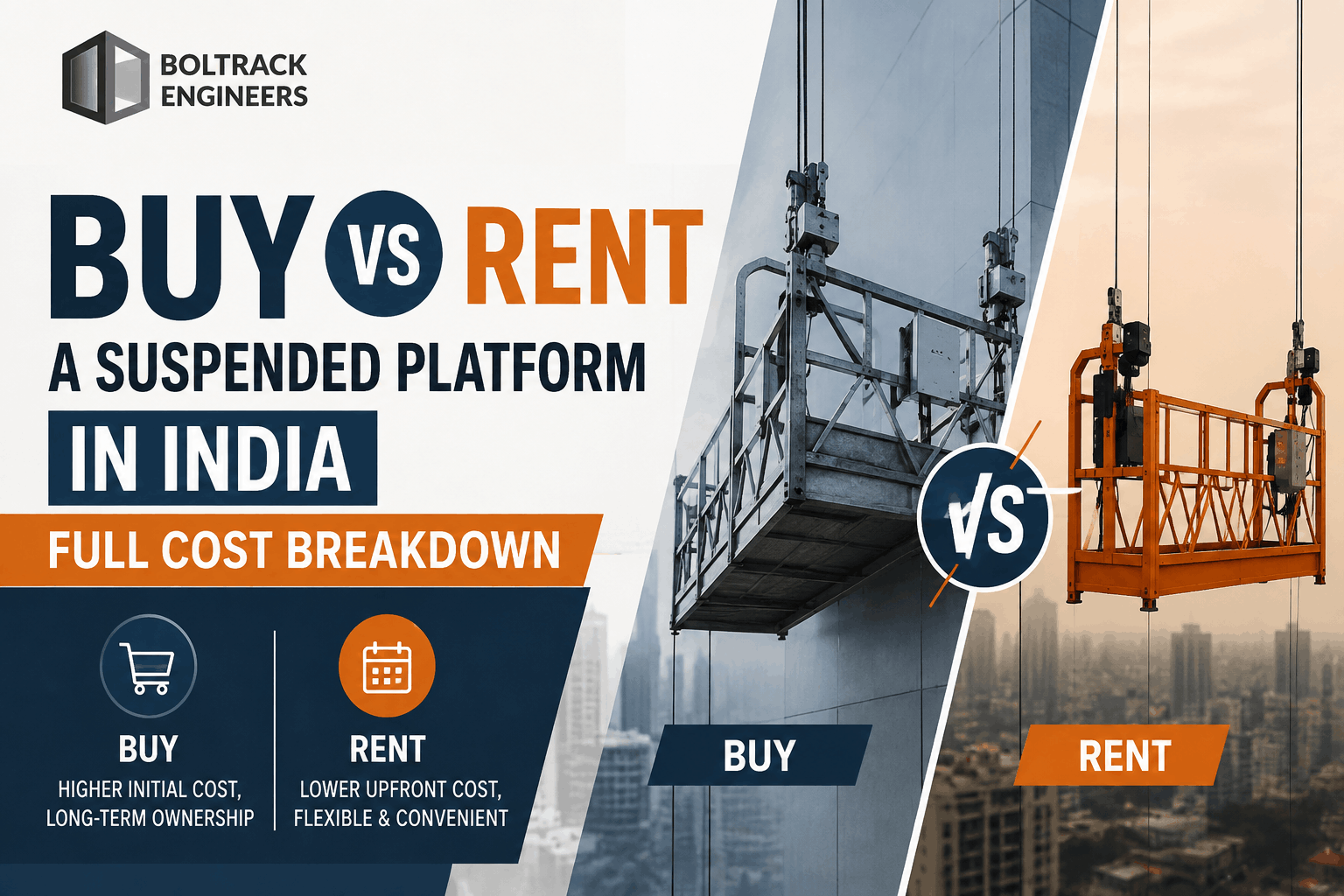
Sooner or later every façade contractor, painting firm and building maintenance company in India asks the same question: is it smarter to buy a suspended platform outright, or to rent one for each job? The honest answer is that it depends almost entirely on how much you will actually use it — but “it depends” is useless when you are trying to price a tender. So this guide puts real numbers against both options, using our own current pricing, and shows you exactly where the two lines cross.
Key Takeaways
• Renting suits one-off jobs and short projects; buying pays back once the machine is in near-continuous, multi-site use.
• A complete ZLP800 starts around ₹2.65 lakh to buy; the range runs from about ₹2 lakh (ZLP500) to ₹3.9 lakh (ZLP1000). Renting the same class of machine is ₹35,000 a month plus transport and installation.
• At those figures the break-even lands at roughly 8 months of actual use — but it is utilisation, not the calendar, that decides it.
• Ownership carries maintenance, storage, certification and idle-month costs that a rental invoice quietly hides.
Contents: What it costs to buy · What it costs to rent · The head-to-head breakdown · The break-even point · Hidden costs of owning · A worked example · The verdict · FAQ
💰 What It Costs to Buy a Suspended Platform
A suspended platform is a complete system — the working cradle, a matched pair of electric hoists, safety locks, the rooftop suspension mechanism with counterweights, wire ropes and the control panel all ship together. That is why a ready-to-run unit costs far more than the bare platform some suppliers quote. Here is our current model-wise pricing for a complete machine.
| Model | Rated capacity | Price (from ₹, per unit) | Typical use |
|---|---|---|---|
| ZLP500 | 500 kg | 2,00,000 | Light façade work, smaller crews. |
| ZLP630 / SPL630 | 630 kg | 2,50,000 | Mid-range painting, plastering, cleaning. |
| ZLP800 / SPL800 | 800 kg | 2,65,000 | The all-round standard on Indian sites. |
| ZLP1000 / SPL1000 | 1,000 kg | 3,90,000 | Heavy façade work — cladding, stone, glazing. |
Prices are per complete unit and exclude 18% GST. L-type corner cradles and round/chimney cradles are configured to the building and priced on request.
So for the most common machine on Indian sites — the 800 kg ZLP800 — you are realistically writing a cheque for about ₹2.65 lakh plus GST, or roughly ₹3.13 lakh all-in. That is the number to plan around, not the platform-only figure that gets thrown about.
→ Explore the full Boltrack suspended platform range
📅 What It Costs to Rent a Suspended Platform
Renting replaces that single large outlay with a predictable monthly figure, plus a few one-time charges each time the machine moves to a new site. Our standard ZLP800 rental is ₹35,000 a month; the extras below are typical of the Indian market and vary by city and distance. For current city-specific rates, see our city-wise rental price guide.
| Charge | Cost (₹) | Frequency |
|---|---|---|
| Monthly rental (ZLP800) | 35,000 | Per month, per unit |
| Transport (to and from site) | 8,000 – 20,000 | One-time, per deployment |
| Installation + dismantling | 10,000 – 25,000 | One-time, per deployment |
| Refundable security deposit | 40,000 – 75,000 | Returned at the end (not a cost) |
The important detail most people miss: transport and installation repeat every time the machine moves. If you run four short jobs in a year, you pay those one-time charges four times over. Rent one machine on one long project and you pay them once. This single fact is what makes utilisation — not months on the calendar — the number that actually decides buy versus rent.
📊 The Head-to-Head Cost Breakdown
Let’s put both options on the same timeline for a ZLP800. We’ll use a purchased unit at ₹2,65,000 (one-time), maintenance folded in at about ₹3,000 a month, against a rental at ₹35,000 a month with a single ₹25,000 transport-and-install charge for one continuous deployment.
| Duration of use | Cost to rent | Cost to own | Cheaper option |
|---|---|---|---|
| 1 month | ₹60,000 | ₹2,68,000 | Rent |
| 3 months | ₹1,30,000 | ₹2,74,000 | Rent |
| 6 months | ₹2,35,000 | ₹2,83,000 | Rent |
| 8 months | ₹3,05,000 | ₹2,89,000 | ≈ Break-even |
| 12 months | ₹4,45,000 | ₹3,01,000 | Own |
| 18 months | ₹6,55,000 | ₹3,19,000 | Own |
| 24 months | ₹8,65,000 | ₹3,37,000 | Own |
Read down that “cheaper option” column and the story is clear. For anything up to about seven or eight months of continuous use, renting wins — you avoid locking ₹2.65 lakh into a machine that will sit idle the moment the job ends. Past the eight-month mark the owned unit has paid for itself, and every month after that it earns its keep. Because our rental rate is a real ₹35,000 a month, ownership crosses over noticeably faster than most contractors expect.
🎯 Where the Two Lines Cross
The rule of thumb we give customers is simple: if a single machine will be working for more than eight months in total, buying is cheaper than renting. Below that, rent.
But the calendar version of break-even hides a trap worth spelling out. The table above assumes one long continuous deployment. Real work is lumpier than that. A firm that owns a machine and keeps it busy across back-to-back projects reaches payback fast. A firm that owns a machine but only uses it three months a year is quietly paying for storage, maintenance and depreciation on an asset that earns nothing for nine months — and would have been better off renting each time.
💡 The one number to know: divide the purchase price by the monthly rental. ₹2,65,000 ÷ ₹35,000 ≈ 8 months. If you will genuinely put the machine to work for more than that many months over its life, owning is the cheaper path.
🧮 The Hidden Costs of Owning
Purchase price is the visible half of ownership. The other half turns up quietly over the years, and it is the part that catches first-time buyers off guard.
Maintenance and spares. Hoists need servicing, wire ropes wear and get replaced, safety locks are tested and recertified. Budget a few thousand rupees a month averaged over the year. (We stock genuine spare parts for exactly this reason.)
Storage. A dismantled system takes real space and needs to stay dry. Rope and electricals left out through a monsoon are how a working machine becomes scrap.
Certification and inspection. Owned access equipment has to be inspected and certified periodically to stay compliant on site. That is your responsibility as the owner, not the rental company’s.
Idle time and depreciation. Every month the machine sits unused, it still loses value. A rental invoice stops the day the job ends; an owned asset keeps depreciating whether it is working or not.
⚠️ Never let cost logic override safety. Whether you buy or rent, a suspended platform must run with harnesses, a tested safety lock and correctly calculated counterweights — every single time. The cheaper machine is never the one missing its safety gear.
🏗️ A Worked Example
Two contractors, same city, very different answers.
Contractor A has won a single painting contract on one 14-storey building. The work will take about four months and then it’s done. Renting costs him roughly ₹1,65,000 all-in (four months at ₹35,000 plus one ₹25,000 transport-and-install). Buying would tie up ₹2.65 lakh in a machine he has no next job for. He rents — no contest.
Contractor B runs a façade maintenance business with eight to ten sites a year across Ahmedabad and Rajkot, and the work never really stops. Renting would mean paying transport and installation eight-plus times a year and a ₹35,000 cheque every month regardless — comfortably past ₹5 lakh annually. For him a ₹2.65 lakh machine pays for itself inside eight months and saves money every year after. He buys — and probably buys two.
✅ The Verdict
Rent when the work is a one-off, when the project is under about eight months, when your workload is seasonal or unpredictable, or when you simply don’t want capital locked up in equipment. You get a site-ready machine, someone else handles maintenance and certification, and the cost ends when the job ends.
Buy when you have steady, repeating façade work, when the machine will stay genuinely busy, and when you’d rather own an asset than write a ₹35,000 cheque every month. Past the eight-month mark, ownership is simply cheaper.
If you are somewhere in the middle — growing, but not certain the pipeline will hold — renting first and buying once your utilisation is proven is the low-risk way through. Plenty of Boltrack customers start on rental and switch to purchase in their second year, once the numbers make the decision for them.
Get a Free Quote → See Our Projects
❓ Frequently Asked Questions
Is it cheaper to buy or rent a suspended platform in India?
For short or one-off projects, renting is cheaper — you avoid a ₹2.65 lakh-plus outlay and only pay for the time you use. For continuous work, buying is cheaper once the machine has been in use for about eight months, after which ownership costs less than the equivalent rental. The deciding factor is how many months in total the machine will actually work.
How much does it cost to buy a suspended platform?
A complete Boltrack unit ranges from about ₹2,00,000 for a 500 kg ZLP500 to ₹3,90,000 for a 1,000 kg ZLP1000, before GST. The most popular model, the 800 kg ZLP800, starts at ₹2,65,000. These are complete-system prices — platform, hoists, safety locks, suspension mechanism and electricals — not a platform-only figure.
What is the monthly rental for a suspended platform?
A ZLP800 rents at ₹35,000 a month, plus one-time transport and installation charges and a refundable security deposit. Rates vary by city — our city-wise rental price guide gives current figures for major Indian cities.
What is the break-even point between renting and buying?
Divide the purchase price by the monthly rental. A ₹2.65 lakh ZLP800 against a ₹35,000 rental breaks even at about eight months of use. If the machine will work more than that over its life, buying is the cheaper option; if not, keep renting.
What costs do people forget when buying a suspended platform?
The costs that surprise first-time buyers are maintenance and spares, dry storage, periodic inspection and certification, and depreciation during idle months. A rental agreement bundles most of these in and stops when the job ends; an owned machine carries them whether it is working or not.
Can I rent first and buy later?
Yes, and for many growing contractors it is the smart route. Renting on early projects keeps capital free and proves your real utilisation. Once the machine would be busy enough to pay for itself, you switch to purchase. Boltrack supplies both, so moving from rental to ownership is straightforward.
About Boltrack Engineers
Boltrack Engineers is a manufacturer, supplier and rental provider of suspended platforms, cradles, gondolas and construction equipment, based in Bakrol GIDC, Ahmedabad, Gujarat. We supply the ZLP500, ZLP630, ZLP800 and ZLP1000 series, suspended cradle lifts, cantilever crane loading platforms, chimney and curved-façade cradles and full spare parts — for outright purchase or monthly rental anywhere in India. New to the equipment? Start with our guide to what a construction gondola is and how it works, or the detailed suspended cradle lift guide.
📞 Sales: +91 78744 95518 | 💬 WhatsApp us | ✉️ Request a quote
