
📅 Last updated: November 2026 ⏱ Reading time: ~8 minutes 📍 Region: India (Pan-India)
Key Takeaways
- “Glass lifter” covers five different kinds of equipment: hand suction cups, vacuum lifters, glass robots, terrace-mounted glass hoists and cranes. Hire the one that matches your panel weight and building height.
- Glass weighs about 2.5 kg per m² for every mm of thickness — a 1.5 m × 3 m, 12 mm panel is about 135 kg before the lifter is added.
- For high-rise façades, a terrace glass hoist such as the Boltrack BE500 (500 kg, up to 100 m) removes the wait for crane time. It is quoted per project for hire or purchase.
- The fastest crews pair a glass hoist with a suspended platform (ZLP800 from about ₹25,000–₹35,000 per month) for fixing and sealing from outside.
- Compare quotes on cost per panel installed, not just the daily or monthly rent.
Contents
🪟 Glass Lifter Options for Hire
When contractors in India search for “glass lifter hire”, they usually need one of five kinds of equipment. Some grip the glass, some lift it, and on a high-rise you usually need both.
- Hand suction cups — single, double or triple-cup handles for carrying and positioning small panels by hand. Cheap and simple, but limited to what the crew can carry.
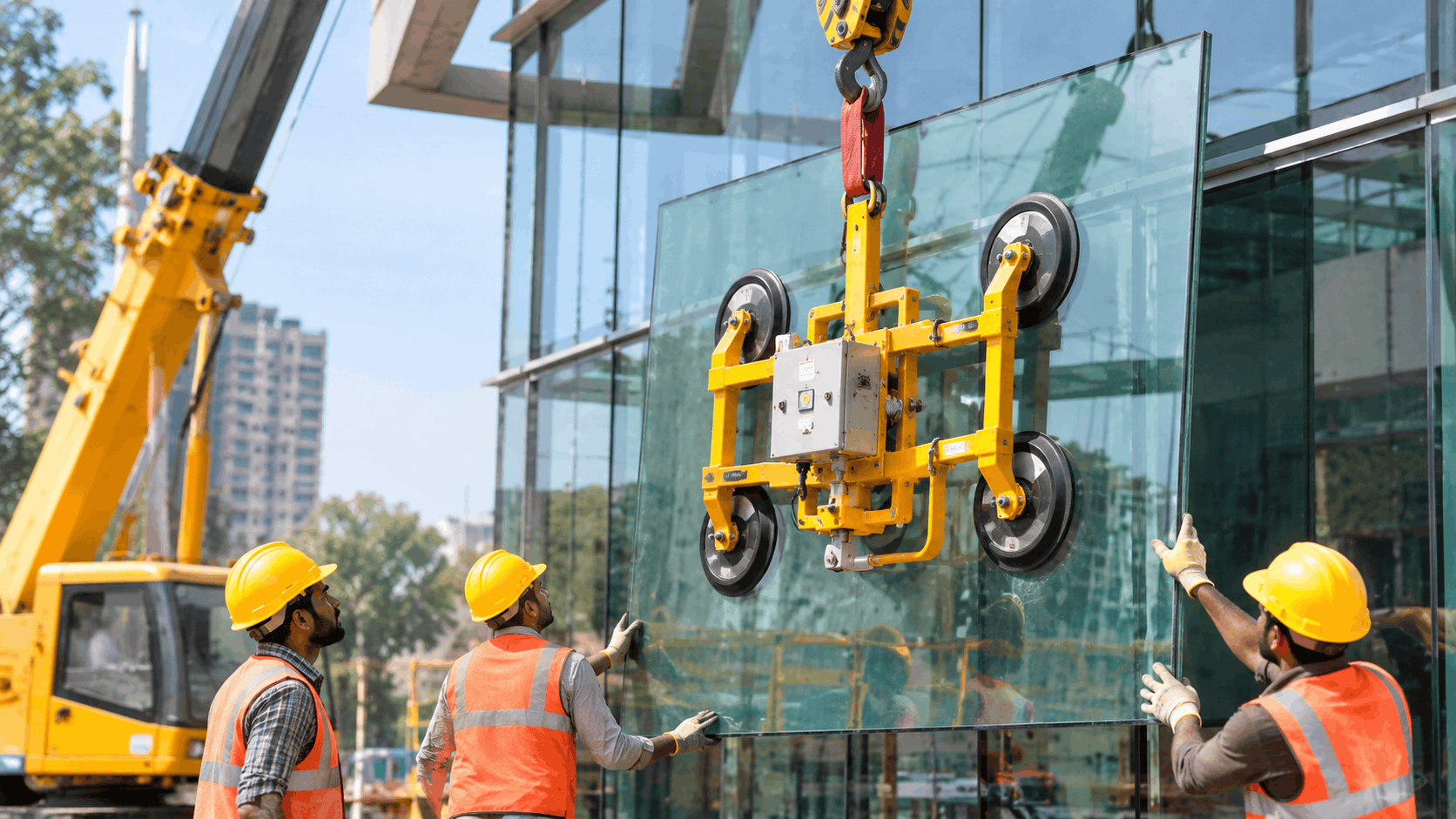
- Vacuum lifter (vacuum lifting attachment) — a battery-powered frame of suction pads that hangs from a crane or hoist hook and grips the panel. It can usually tilt and rotate the glass for fitting. It does the gripping; something else does the lifting.
- Glass robot / mobile vacuum lifter — a self-propelled machine with a vacuum head, used to place glass at low level: shopfronts, ground-floor glazing, partitions and lift lobbies.
- Terrace-mounted glass hoist — a wheeled hoist that sits on the roof and lowers a rope down the façade to lift glass (with a vacuum lifter) to any floor. Built for high-rise work after the tower crane has gone.
- Crane with vacuum lifter — a tower or mobile crane carrying a vacuum attachment. Good for very heavy units, but crane time is expensive and often shared with other trades.
🧭 Which Glass Lifter Do You Need?
| Equipment | Best for | Main limit |
|---|---|---|
| Hand suction cups | Small panels, windows, interior glass | Only what people can safely carry |
| Vacuum lifter | Gripping and tilting heavy panels under a hook | Needs a crane or hoist to lift |
| Glass robot | Shopfronts, ground floor, lobbies, partitions | Low reach; needs level, firm floor |
| Terrace glass hoist | High-rise façades, retrofits, replacements | Needs a roof that takes the counterweight |
| Crane + vacuum lifter | Very large or heavy units; buildings still under construction | Expensive hook time, shared with other trades |
For a detailed look at each method on Indian towers, read our guide to high-rise glass installation equipment, methods and cost.
📏 Work Out Your Panel Weight First
Every hire decision starts with the heaviest single lift. Glass weighs about 2.5 kg per square metre for every millimetre of thickness:
| Glass | Weight per m² | 1.5 m × 3 m panel |
|---|---|---|
| 6 mm toughened | 15 kg | ≈ 68 kg |
| 10 mm toughened | 25 kg | ≈ 113 kg |
| 12 mm toughened | 30 kg | ≈ 135 kg |
| DGU 6 + 12 air + 6 | 30 kg | ≈ 135 kg |
| Unitised curtain-wall panel | Varies | Commonly 200–400 kg |
Approximate glass-only weights. Frames, spacers and sealant add more — check the façade drawings.
Then add the weight of the vacuum lifter, slings and shackles. That total must sit comfortably inside the lifter’s rating and the hoist’s load chart at the outreach you will actually use.
💰 Glass Lifter Hire Costs in India
Glass lifting equipment is usually quoted per project rather than from a fixed price list, because the right setup depends on the panels, height and programme. Here is how each option is charged and what moves the price:
| Equipment | How it is charged | What drives the cost |
|---|---|---|
| Hand suction cups | Usually bought, not hired | Number of cups and rated load |
| Vacuum lifter | Per day, week or month | Capacity, tilt/rotate features, curved-glass pads |
| Glass robot | Per day or week, often with operator | Capacity, reach, transport to site |
| Boltrack BE500 glass hoist | Monthly rental or outright purchase — price on request | Lifting height, rental duration, delivery distance |
| Mobile crane | Per hour or per shift | Tonnage, boom length, minimum shift, permissions |
| ZLP800 suspended platform (for fixing) | About ₹25,000–₹35,000 per month | City, duration; plus ₹5,000–₹15,000 installation |
All Boltrack prices exclude 18% GST. Transport is usually charged separately depending on distance.
💡 Compare cost per panel, not daily rent. A crane that looks cheap per day but gives glazing only a few hours of hook time can cost far more per panel than a dedicated hoist that works the full shift. Divide the total equipment cost by the number of panels you expect to fix.
🧰 Boltrack BE500 Glass Handling Hoist
The Boltrack BE500 is a terrace-mounted glass hoist built in Ahmedabad for high-rise glass placement. It is available on hire and for purchase across India.
| Rated capacity | 500 kg (load-chart based for boom extension) |
| Maximum lifting height | 100 m |
| Lifting speed | 0–20 m per minute, variable |
| Boom | Articulating and telescopic, up to 2,200 mm extension |
| Motor | 5.0 hp double-brake motor (IP55) with helical gearbox |
| Wire rope | 10 mm non-rotating galvanised, 100 m |
| Controls | Wireless joystick remote (200 m range) + wired pendant backup |
| Counterweight | 35 modular steel weights × 50 kg |
| Mobility | 8-inch polyurethane swivel castors with floor locks |
Because the hoist belongs to the glazing team, it can work from first light to last on the floors you choose, without waiting for a crane slot. Pair it with a ZLP suspended platform so the crew outside can fix and seal each panel as it arrives.
⚖️ Hire vs Buy
- Hire if you have a single project, an occasional glass replacement job, or you’re not sure which equipment suits your panels yet.
- Buy if you’re a façade or glazing contractor moving from tower to tower and the equipment will be in use for most of the year.
- Mix both: many contractors own suction cups and a vacuum lifter, and hire the hoist and platforms per project.
The break-even logic is the same as for suspended platforms — see our buy vs rent cost breakdown.
📨 How to Get an Accurate Quote
Send your supplier these details and you’ll get a firm quote much faster:
- ☐ Building height and number of floors to glaze
- ☐ Largest panel size, glass type and thickness (or panel weight)
- ☐ Number of panels and the planned programme
- ☐ Roof or terrace layout, and any projections on the façade
- ☐ Whether you also need suspended platforms for fixing
- ☐ Hire duration, or whether you want to buy
- ☐ Site location (city) for transport
🦺 Safety When Lifting Glass
- Check the vacuum every lift: clean pads, full vacuum reading and a working low-vacuum alarm.
- Use tag lines to stop the panel spinning or swinging into the façade.
- Clear the zone below — nobody stands or walks under a suspended load.
- Stop in wind. Large glass panels act like sails, so stop lifting well before the wind gets strong.
- Trained operators only, with lifting equipment examined by a competent person as the BOCW rules require. See our safety checklist & operator training guide.
🏢 Glazing a tower? Share your building height, panel sizes and programme, and Boltrack will quote the BE500 glass hoist and suspended platforms together. Get a free quote →
❓ Frequently Asked Questions
Can I hire a glass lifter in India?
Yes. Vacuum lifters, glass robots, terrace glass hoists and cranes are all available on hire in India. Boltrack Engineers hires out the BE500 glass handling hoist and suspended platforms, with delivery across India from Ahmedabad.
How much does glass lifter hire cost?
It depends on the type of equipment, capacity, lifting height, hire duration and delivery distance, so most suppliers quote per project. Suspended platforms used for fixing glass cost roughly ₹25,000–₹35,000 per month. Compare options on cost per panel installed.
What is the difference between a vacuum lifter and a glass hoist?
A vacuum lifter grips the glass with suction pads; a glass hoist lifts it. On high-rise jobs the vacuum lifter hangs from the hoist’s rope, so you normally need both working together.
How heavy a glass panel can the Boltrack BE500 lift?
The BE500 is rated for 500 kg, based on its load chart for the boom extension used, and lifts up to 100 m — roughly a 30-storey building. Include the vacuum lifter and rigging in the total load.
Is it cheaper to hire a glass hoist or use a crane?
For glazing after the structure is complete, a dedicated glass hoist is often cheaper per panel because it works the full shift without waiting for crane time. Very heavy units beyond the hoist’s load chart may still need a crane.
What details do I need to share for a glass lifter quote?
Share the building height, largest panel size and weight, number of panels, roof layout, whether you need suspended platforms too, hire duration and the site’s city.
About Boltrack Engineers
Boltrack Engineers is a manufacturer, supplier and rental provider of suspended platforms, glass lifting equipment and construction machinery, based in Bakrol, Ahmedabad, Gujarat. With 1,500+ completed projects and over a decade of experience, we serve façade, glazing and construction contractors across India.
We supply the BE500 glass handling hoist, ZLP800 & ZLP1000, L-Type and gondola platforms for rent and sale pan-India.
📞 Sales: +91 78744 95518 | 💬 WhatsApp us
