
📅 Last updated: November 2026 ⏱ Reading time: ~9 minutes 📍 Region: India (Pan-India)
Key Takeaways
- Under India’s Building and Other Construction Workers (BOCW) Act, 1996 and its Central Rules, lifting appliances must be examined by a competent person and used only by trained workers. Keep the records on site.
- Check the gondola at four stages: before installation, after installation, before every shift, and at the end of every shift.
- The checks that matter most are counterweights, wire ropes, the safety lock, the emergency stop and the workers’ own lifelines.
- Every worker on the platform wears a full-body harness clipped to an independent lifeline — never to the platform itself.
- Operator training should cover the machine, daily checks, safe operation, emergencies and rescue — with a practical test before anyone operates alone.
Contents
📜 Gondola Safety Rules in India
In India, suspended platforms on construction sites fall under the Building and Other Construction Workers (Regulation of Employment and Conditions of Service) Act, 1996 and the BOCW Central Rules, 1998, along with the rules framed by each state. In plain terms, these require that:
- lifting appliances and their gear are tested and examined by a competent person at the intervals the rules set, and the results are recorded;
- only trained, competent workers operate them;
- workers at height are given and use suitable fall protection;
- the safe working load is clearly marked and never exceeded.
On factory and industrial sites, the Factories Act and the state factory rules also apply. Internationally, suspended access equipment is designed to EN 1808, which many Indian contractors and clients use as the reference standard.
💡 This guide is practical site guidance, not legal advice. For exact inspection intervals and forms, check the BOCW rules for your state with your safety officer.
📝 Checklist 1: Before Installation
- ☐ Roof slab and parapet inspected and confirmed strong enough for the suspension.
- ☐ Drop positions marked, clear of balconies, AC units, signboards and projections.
- ☐ Overhead power lines identified and a safe distance confirmed.
- ☐ Full set of counterweights on site — the number in the manufacturer’s manual.
- ☐ Ropes long enough for the full drop, with spare length at the bottom.
- ☐ Correct power supply available, with earth-leakage protection.
- ☐ Separate anchor points on the roof for workers’ lifelines.
- ☐ Equipment test and inspection certificates received from the supplier.
- ☐ Installation by a trained technician, not by the work crew.
🔧 Checklist 2: After Installation (Before First Use)
- ☐ Suspension beams level, supports locked, outreach as per the manual.
- ☐ All counterweights fitted and locked, or parapet clamp fully tightened.
- ☐ Working and safety ropes correctly threaded through hoists and safety locks; rope weights fitted.
- ☐ Platform sections bolted, guardrails and toe boards complete.
- ☐ Empty run up and down the full height completed.
- ☐ Safety lock, emergency stop, upper limit switch and brakes tested and working.
- ☐ Load test completed and recorded.
- ☐ Safe working load (SWL) displayed on the platform.
- ☐ Examination by a competent person recorded before handover.
✅ Checklist 3: Daily Pre-Use Check
The operator does this before every shift, and nobody goes up until every item passes. Print it and keep it on the platform.
| Part | What to check | OK? |
|---|---|---|
| Roof suspension | Nothing moved overnight; all counterweights in place; clamp tight. | ☐ |
| Wire ropes | No broken wires, kinks, crushing, rust, or paint/cement build-up. | ☐ |
| Rope weights | Fitted and hanging free, ropes not tangled. | ☐ |
| Hoists | No unusual noise, smell or oil leak; brake holds when stopped. | ☐ |
| Safety locks | Tested as per the manual; not tied back or blocked. | ☐ |
| Controls | Up/down work; emergency stop cuts power; upper limit switch works. | ☐ |
| Power cable | No cuts or exposed wire; protected at the parapet edge. | ☐ |
| Platform | Bolts tight; guardrails and toe boards complete; deck clean and dry. | ☐ |
| Lifelines & harnesses | Lifelines anchored independently; harnesses and rope grabs undamaged. | ☐ |
| Ground zone | Area below barricaded with a “Work Overhead” sign. | ☐ |
| Weather | No rain, lightning or strong wind; within the manufacturer’s wind limit. | ☐ |
If any item fails, tag the gondola “Do Not Use” and call the supplier’s technician. Don’t let the crew try to fix hoists, safety locks or ropes themselves.
🦺 Rules During Work
- Harness on, always clipped to an independent lifeline with a rope grab — from the moment you step on until you step off.
- Never exceed the safe working load. Count people, tools and material together.
- Spread the load evenly along the deck; don’t pile material at one end.
- Keep the platform level. If it tilts, stop and lower it under control.
- Never climb on or lean over the guardrails, and never use ladders or stools on the platform.
- Never get on or off between floors — only at the roof or ground level.
- No welding near the wire ropes without protection and permission.
- Bring it down in bad weather — rain, lightning or strong wind.
🌙 Checklist 4: End of Shift
- ☐ Platform lowered to ground level (or secured at the roof), never left hanging mid-height.
- ☐ Tools, material and waste removed from the deck.
- ☐ Main power switched off and the control box locked.
- ☐ Hoists and control box covered against rain and dust.
- ☐ Any faults written in the logbook and reported.
- ☐ Barricades left in place if the ropes are still hanging.
🚨 Emergencies & Rescue Plan
Every site using a gondola needs a written rescue plan before work starts. It should cover:
- Power cut: how a trained operator uses the hoist’s manual descent to lower the platform slowly and evenly at both ends.
- Safety lock activated: stay calm, stay clipped to the lifeline, and call the supervisor. Don’t try to release the lock yourself.
- Stuck platform: how workers will be reached — from a window or balcony, from the roof, or with a second platform.
- Worker suspended in a harness: how they will be rescued quickly — suspension in a harness becomes dangerous within minutes.
- Contacts: site supervisor, supplier’s technician and nearest hospital, with phone numbers on the platform.
🎓 Operator Training: What It Should Cover
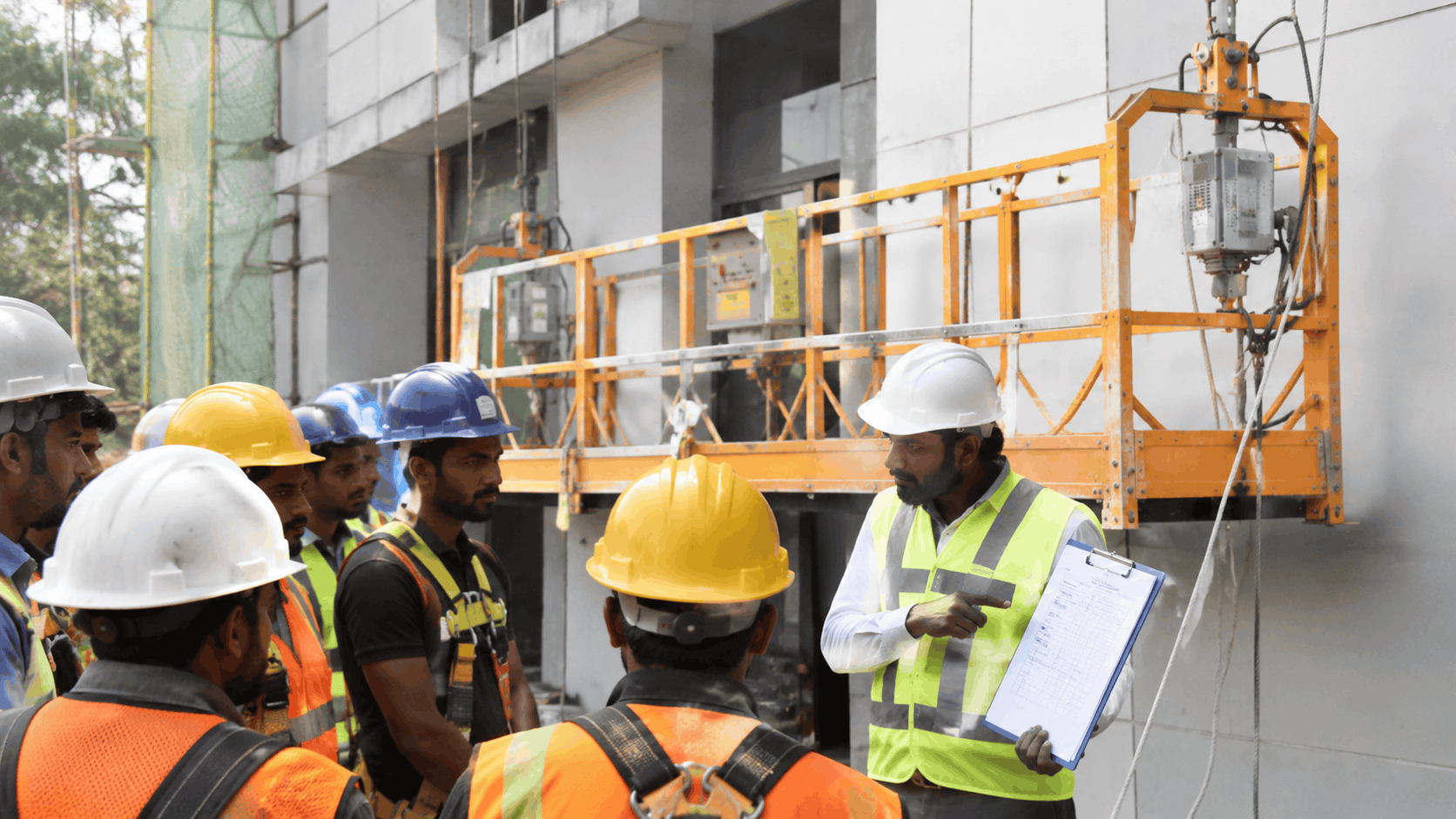
“Trained worker” means more than having watched someone else operate the machine. A good operator training programme covers:
| Module | What the operator learns |
|---|---|
| 1. Know the machine | Every part and what it does — see our gondola parts guide. |
| 2. Daily checks | How to do the pre-use checklist and spot rope and hoist faults. |
| 3. Safe operation | Load limits, keeping level, getting on and off, weather limits. |
| 4. Fall protection | Wearing and checking a harness; using a lifeline and rope grab. |
| 5. Emergencies | Emergency stop, manual descent in a power cut, safety-lock activation. |
| 6. Rescue drill | Practising the site rescue plan at least once before work starts. |
| 7. Practical test | Operating under supervision and passing a check before working alone. |
Tips for contractors:
- Train in the workers’ own language — Hindi, Gujarati or the local language — with a hands-on demonstration, not just a talk.
- Keep a training register with names, dates and who trained them.
- Give a short toolbox talk every morning before going up.
- Ask your supplier for an on-site handover covering operation and emergency descent when the platform is installed.
🏗️ Renting a gondola? Ask Boltrack about installation by our technicians and an operator handover when you book. Talk to our team →
❓ Frequently Asked Questions
What safety checks are needed before using a gondola?
Before every shift, check the roof suspension and counterweights, wire ropes, rope weights, hoists, safety locks, controls and emergency stop, power cable, platform guardrails, workers’ harnesses and lifelines, the barricaded zone below and the weather.
Which law covers gondola safety in India?
On construction sites, the Building and Other Construction Workers Act, 1996 and the BOCW Central Rules, 1998, along with state rules, cover lifting appliances and work at height. They require competent-person examination, trained operators and fall protection.
Do gondola workers need a safety harness?
Yes. Every worker on the platform should wear a full-body harness clipped with a rope grab to an independent lifeline anchored on the roof — not to the platform, its ropes or its suspension.
Who can operate a gondola?
Only a trained and competent operator who understands the machine, the daily checks, safe operation and emergency procedures, and who has passed a practical check under supervision.
What happens if the power fails on a gondola?
The hoist brakes hold the platform in place. A trained operator can then use the manual descent lever on each hoist to lower the platform slowly and evenly to the ground.
Can a gondola be used in rain or wind?
No. Stop work and bring the platform down in rain, lightning or strong wind, and always follow the manufacturer’s maximum wind speed for the model you are using.
About Boltrack Engineers
Boltrack Engineers is a manufacturer, supplier and rental provider of suspended platforms and construction equipment, based in Bakrol, Ahmedabad, Gujarat. With 1,500+ completed projects and over a decade of experience, we serve contractors, builders and maintenance teams across India.
We supply ZLP800 & ZLP1000, L-Type, chimney platforms, gondolas and more for rent and sale pan-India.
📞 Sales: +91 78744 95518 | 💬 WhatsApp us
